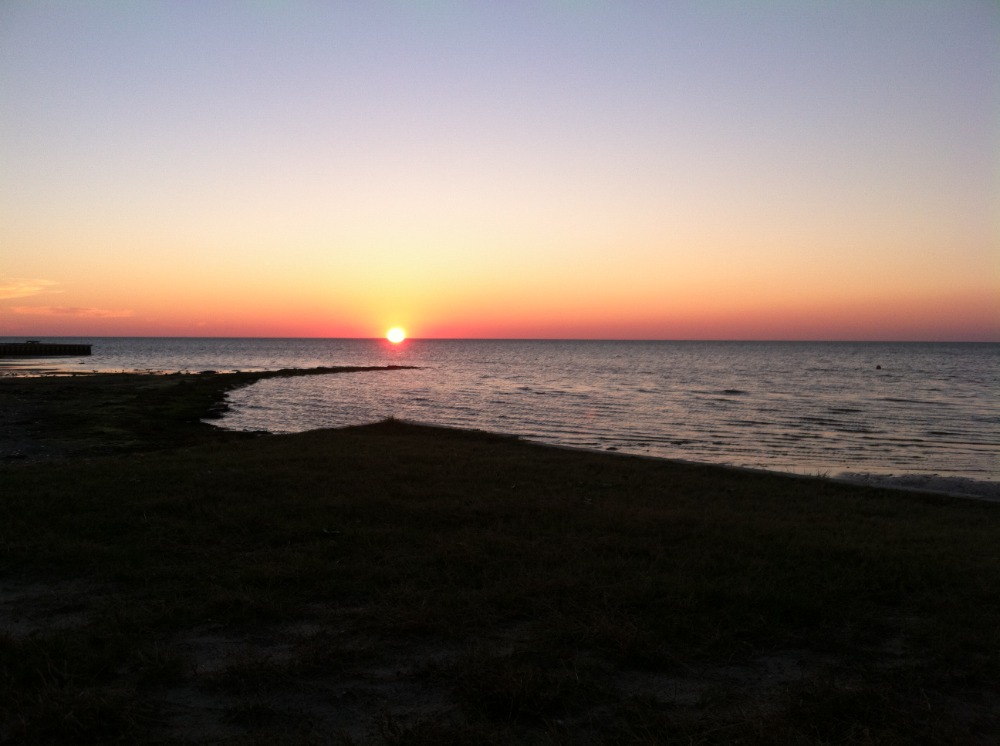
Photo: Sunset Outerbanks, North Carolina, Guy Heidenreich, November 2013
(Earlier: Chapter 2 Taking on the Lion https://onthebeachatnightalone.com/2022/08/15/fiction-the-girassian-debacle-chapter-2-taking-on-the-lion )
Engineers likened the function of a droid pilot to a consciousness for the starships of the United League of Earth’s Star Force, a meta- system overlaying all of the subsystems of the ship. The integration added a higher functionality critical in combat. With advancements in quantum computing, the ship’s integrative system was pulled out of the mainframe and put into a mobile unit, the quantum droid pilot. The pilot could move around the ship, plugging into ports throughout the ship’s sections to run local diagnostics, while remaining the overseer of all the systems. This insured that the quantum droid pilot could control the ship from any point in case the bridge sustained damage.
Computing potential moved to a level beyond that of quantum computing with the refinement of DNA circuitry set in biologic medium. A biodroid pilot with its neurocircuitry working with the ship’s system performed superiorly to the quantum droid pilot. For the safety of redundancy, the biodroid pilot, or BDP, would be connected to a quantum droid pilot via the ship’s wireless network. The BDP would upload a constant stream of data in realtime so that there was a mirror copy of itself. The quantum droid pilot, secured on the bridge, did not have the same functionality as the new biodroid, but it would protect the ship if the biodroid became damaged.
The Research Division of the United League of Earth’s Star Force knew how to keep things top secret when necessary. Only vague rumors escaped from classified projects. This was especially true with work on the biodroid. Supposedly its interface with the ship was seamless, the same as the current module of quantum droid pilot. A seamless of functionality was going to be critical if the crew of the London was to integrate and test the system before embarking for Mars as part of the Task Force Renewal in less than ninety-six hours.
The London had just returned to Earth’s Alpha One Base from a point-seven voyage, the equivalent of two hundred and fifty-six terran-days. This duration pushed past the limit of usual deployment and the crew was tired and stressed, having engaged two pirate ships in separate actions. Now, not only would they not get any time off on earth, the crew was going to work extra hard to provision and prepare the London in a fraction of the time normally allotted to a ship back from a mission.
The twenty-four hours of leave granted on the station barely allowed the crew to stretch out their spirits from the claustrophobic environment of the small corvette. It did not provide enough time to unwind from the pressure of being on top of one another, immersed in a boring routine punctuated by moments of terror.
—————
Chief Engineer Gerhard Freihoff waited anxiously for the delivery of the new biodroid pilot. London’s officers were going to be lucky if they would get even a watch’s-worth of time to enjoy the amenities of the station. They had to work with a new droid to integrate and then test it inside their command’s respective systems. If there was any way he could free his own reports for more time off, he would try.
He had no idea what the unit was going to look like. All he knew was that it was more independent than London’s current quantum droid pilot. The design engineers of the quantum droid pilot had failed to account for the absence of securing bays in the ship. Someone always had to tend the droid when it moved about the ship in order to help attach it to the bulkhead if they went into 0-gravity. Free floating droids were dangerous . The new biodroid was rumored to be self-sufficient in this regard. It followed, most officers anticipated a humanoid android to replace the current bullet-shaped canister that was rolling about ships.
Chief Freihoff enjoyed working with the London’s droids. Artificial intelligence allowed them to develop personalities of sorts. He was careful not to get attached to a quantum droid pilot since they were frequently being swapped out for a newer module. He frequently reminded himself that they were only manufactured circuitry. He conducted himself with the utmost scientific professionalism.
He was halfway through the check-in and had found only three problems needing to be fixed. Freihoff had known about two of them before starting the check-out and would have already been working on them before coming into Alpha-One had there been more time.
A squeak made Freihoff look up at the reactors. He was attuned to every noise in the engineering section and this was a new one, quite prominent over the low drone of the reactors. He held breath. He hated it when the reactors made any noise other than their low hum. Gerhard heard the squeaking again, realizing it came from outside of engineering, a series of high pitched intonations echoing in the hall.
Second lieutenant John Pitt entered the section, looking sheepish and apologetic. He straddled the door looking back at the passageway. After about ten seconds he started to wave something forward. “We’re here. Come on. Come in and meet Chief Freihoff.”
Around the door’s edge stepped a miniature humanoid, maybe a meter tall, carrying a large duffle bag as large as its body. Its head was just short of the entire length of the rest of the body. Gerhard wondered how it could hold up its head. The head was wide with large brown eyes set wide apart. Freihoff thought of one of his daughter’s dolls, based on an ancient figure, that was all head, all smiling eyes with a small body. He could not believe this was the biodroid.
“Is this a joke, Pitt? Where did you get such a thing. I thought you were retrieving our biodroid to plug in. We have no time to play around.”
“Sir. This is our biodroid pilot. See how large its brain case is!”
“No,” Freihoff said. “This is a bad joke. Did you insist on getting the real unit? If this is the real unit, they sent a defective one.”
“Sir, they were dead serious.”
The unit looked from Freihoff to Pitt and back as they spoke. It had a mop of tussled hair that bobbed as it swung its head back and forth. Freihoff turned away and shook his head. Turning back he said. “What is your identity?”
“Your RXC-42 biodroid pilot is here. Fourth generation. Latest model now being deployed in the Star Force. Assigned to the ULE London. It is hungry. It has been twenty-nine hours without nutrition. Do you have any fast energy food?”
“What does it come with, a feeding and care manual?” Freihoff said.
“They told me it is a high energy consumer and would be looking for food right away,” Pitt said.
“I am told the ULE London needs me to integrate with the overall rdfrsystem and the crew as soon as is possible. Discussing disbelief in my appearance interferes with ‘as soon as is possible’.”
“I’m serious. What do we feed it?” an exasperated Freihoff said.
“Maybe we ask it?” Pitt said
“Well? What powers you and for how long?” Freihoff said.
“The RKC-42 model performs optimally with one power bar every twenty-four hours.”
“How long can you go right now, without shutting down?” Freihoff said.
“This RKC-42 will shut down in eleven hours. Work output will slow down in seven hours.”
“Chief, I’ll go to the galley and get some power bars.”
Pitt left Engineering at a near run, leaving Freihoff staring at the biodroid. He called the bridge. “Captain? XO? Can you come down here to Engineering. Our BDP showed up. You have to come and see it to believe it. No screen view will do it justice.”
While Freihoff spoke, the RXC-42 biodroid wandered about the engineering section, looking around.
“What are you looking for?”
“The RKC-42 BDP is looking for a place to set its bag,” the biodroid said.
“Here, let me take that from you,” said Freihoff taking the bag from the biodroid. He found a ledge high above its reach and secured the bag with straps.
“Now what are you looking for?”
“To start the work of check-in, a stool or ladder is needed.”
“You don’t come with cables that reach our ports?” Now it was Freihoff’s voice that squeaked.
“Yes. The cables reach. This unit is most efficient when elevated.”
“Is that a defect?” Freihoff said.
.
“There is no defect. Being elevated is an enhancement of functionality.”
Freihoff swung out a seat at a console of near the reactor and looked from the seat to the biodroid skeptically. While he looked from the seat to the biodroid, it crouched and hopped up onto the seat with the adeptness of a cat jumping onto a counter. The seat spun and the biodroid raised its arms for balance. Once stable, it pulled out cables from behind its neck and plugged into the network.
“What is this?” Captain Maureau said. Behind him, gathered in the doorway, stood the XO, Lieutenant Commander Song, and Lieutenants Akhtar-Gatewood of Navigation and Madelaine Gray of Security. Lieutenant Wu was behind them, trying to see between them.
“We all came down to see the new pilot,” Akhtar-Gatewood said. “Where is it?”
“This little one is it,” said Freihoff. They were all staring, speechless. As they stepped into the Engineering section, Pitt came back from the galley and offered the biodroid a power bar. It took it from him, ignoring the group and started to chew it slowly, eyes closed, head bent down. It was crouched with its buttocks nearly touching the console’s seat, making it appear even shorter than it was. It had one arm touching the reactor. With eyes closed and head bowed, it looked like it was praying for the reactor, trying to heal it.
“What’s it doing?” Gray said. She had stepped next to Maureau.
“It looks like it’s meditating,” said Maureau.
Pitt explained to the group how he had gone to Alpha One’s Technology Section to bring the new biodroid over and protested that this gnome-like entity could not possibly be the pilot for a United League of Earth ship of war. He was assured it was. Now, as the group discussed their incredulity, it appeared to be checking the London’s drive system.
“How is it inside our system? Did you give it access?” Gary spoke with an intensity that was often in your face. She was taller than Freihoff and stood looking down on him. Her light brown eyes were golden in the light of the Engineering section. Her short auburn hair, high set ears, and tapered jaw made her look severe, even feline. Tensed musculature gave the appearance she was about to pounce on Freihoff.
“I don’t think that is possible,” Freihoff said. “It must be awaiting orders, while, ah, refueling, as it were.”
“Confirm that,” Gray said.
“Ah, London RKC-42 BDP ? Are you in the system?”
“We need to give it a name,” Maureau said.”
The biodroid’s eyes popped open and it swallowed. “Yes. Your RKC-42 BDP is done checking the drive reactors.”
“That’s impossible!” Freihoff and Gray said in unison.
“You just plugged in. It takes at least an hour to check-in the drives,” Freihoff said over Gray’s “How did you get into the system without authorization?”
The BDP looked at Freihoff. “You can adjust the RKC-42 BDP’s work speed down if desired. Slowing it down does not improve the accuracy of the unit, nor conserve energy. Do you want your RKC-42 BDP to slow down?” It waited for an answer, its hand held in suspension half way to its mouth with the remainder of the power bar.
Freihoff looked uncomfortable, embarrassed to be interacting with the BDP in front of the officer staff. “No, no. Hold your functioning level at its current level.”
The unit turned and looked at Gray who was glaring at it. “Lieutenant Gray, your RKC-42 BDP is assigned to run a check-in of the London’s systems. Chief Freihoff ordered it to plug in. It did not wait for a “go” order. Your system was wide open to the RKC-42 BDP. The London’s RKC-42 BDP can improve the security if given an order.”
The BDP took another bite and closed its eyes. Maureau said, “It’s ‘meditating’ again. I wonder if it’s half way through Navigation’s systems. I recommend we do no underestimate this little fellow.”
Kristina Song stepped up and around Gray and carefully inspected the biodroid. “You’re right. It is kind of cute. Chief, you better find out what it’s doing right now.”
“RKC-42! Stop all check-in analysis, now. What information do you already have for us?”
The RKC-42 BDP opened its eyes again. “Analysis of Engineering’s reactor drives is complete. Analysis of Navigation is eighty-five percent complete. Do you want the results?”
“I wonder if you can modulate its voice. That squeak is grating,” Gray said. Freihoff ignored her.
“Let’s see the check-in of the drive reactors,” Freihoff said.
“The report has been sent to your box.”
Freihoff took his tablet off his belt and studied it. He read the biodroid’s report.
“Well, Chief. What do we have?” Song said.
“According to this report, the reactors have four items to optimize. One is potentially a significant drive problem at a forty-five percent probability. It needs urgent repair.” He cleared his throat. “Three of these problems I already knew about before starting the check-in. They were minor and could wait until we docked. The significant drive error was missed by the check-in we just completed. We will need to confirm it and, of course, act on it. That really concerns me.”
“Well, Captain. I knew you would be interested in our new pilot. Pretty damn efficient, I guess.” Freihoff spoke begrudgingly. “All the section officers will get to spent time with it.”
Song bent slightly forward with her hands on her hips while shuffling backwards. Gray needed to back up and move aside. Neither acknowledged one another.
She smiled and the RKC-42 BDP looked at her. “Well, little one, not-to-be-underestimated. We need to assign you, no give you, a name. ‘London RKC-42 BDP’ is way too awkward.” She stood up tall, throwing her shoulders back, and looked at Freihoff, raising her eyebrows. Then, as if an idea just hit her she turned again to the biodroid.
“So, what name would you like for yourself?”
The London’s RCK-42 biodroid pilot closed its eyes with its hands folded at its waist. Its cheeks tensed slightly.
“I think you asked it a question it can’t answer,” Gray said. “You’ve presumed a droid can have a personal desire.”
Song locked eyes with Gray for an instant. “Maybe,” Song said. “What do you think, Chief?”
“I think it’s working very hard and showing it on its face.”
“Yoshi,” it chirped.
“What?” everyone said together. Gray and Ahktar-Gatewood laughed. Wu ooo’ed. Maureau looked at Song who beamed triumphantly, the biodroid looking earnestly at her.
“You want to be ‘Yoshi’?”
“Yes. I am Yoshi.” Yoshi smiled ever so slightly.
“And so it is,” the XO said. Turning towards Freihoff but addressing Gray, she said, “Chief, get to work with Yoshi and then send him to Security next. That is critical for our check-in. I’m sure it can retain its work on Navigation. With that, she left the Engineering section. Captain Maureau followed her.
Next: Chapter 4 This is Not Impressive https://onthebeachatnightalone.com/2022/09/23/fiction-the-girassian-debacle-chapter-4-this-is-not-impressive/
 On the Beach At Night Alone
Live this chapter. Very engaging!
LikeLike